For many Managed Service Providers (MSPs), the “Quarterly Business Review” (QBR) has become a dreaded administrative hurdle. It’s often a reactive session where the account manager defends a stack of tickets, justifies a slight price increase, and hopes the client doesn’t ask why they’re paying for a backup service that failed once last month.
If your QBRs feel like a defensive posture, you aren’t just losing time you’re losing revenue.
The shift from a “vendor” to a “strategic partner” happens through the vCIO (Virtual Chief Information Officer) Framework. By evolving the check-in into a roadmap discussion, you move MSP sales from a transactional pitch to a consultative necessity. You stop selling “seats” and start selling “business outcomes.”
The Gap Between Technical Debt and Business Goals
Most small-to-medium businesses (SMBs) operate in a state of perpetual technical debt. They buy hardware when it breaks and software when a specific pain point becomes unbearable. As an MSP, if you only show up when things are broken or to report on how things didn’t break you are perceived as a utility, like the electric company.
Strategic MSP marketing focuses on positioning your firm as the bridge between current technical chaos and future scalability. The vCIO framework is the tool that crosses that bridge.
Why the “Check-in” Fail
- It’s Rearview-Oriented: Spending 45 minutes on “uptime reports” tells the client what they already know (the internet worked).
- It’s Feature-Heavy: Talking about “Endpoint Detection and Response” (EDR) instead of “Mitigating Financial Ransomware Risk.”
- 3. It Lacks Budgetary Logic: Asking for $10,000 for a server refresh at the end of a meeting without prior warning is a recipe for a “no.”
To fix this, we need to dismantle the traditional QBR and replace it with a high-level strategic roadmap that focuses on the next 24 to 36 months of the client’s business life cycle.
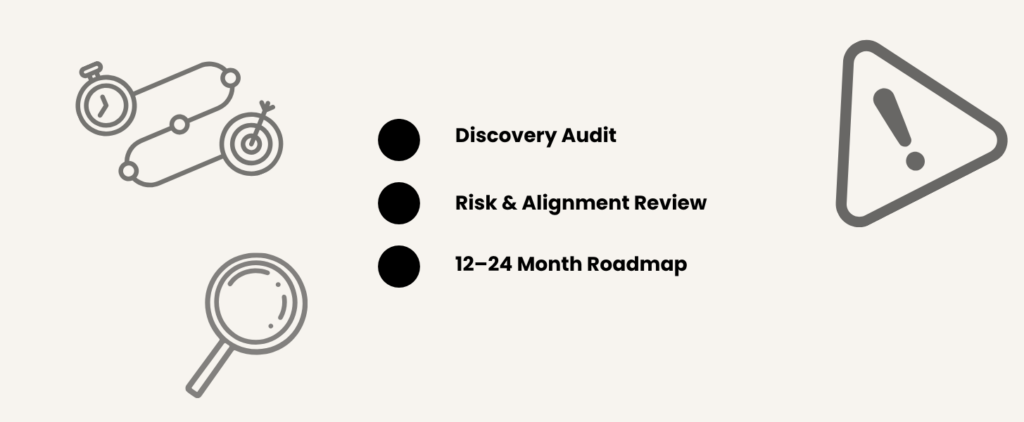
Phase 1: The Discovery Audit (Setting the Stage)
Before you can build a roadmap, you need to understand the client’s business trajectory—not just their server rack. A true vCIO doesn’t start with a scan; they start with a conversation with the CEO or CFO. This is the “Business Intelligence” layer that most MSPs skip because they are too eager to talk about technology.
The Executive Interview
In the MSP sales process, the discovery phase is where you earn the right to lead. You aren’t looking for broken printers; you’re looking for operational friction.
Key Questions for vCIO Discovery:
“What are your top three business goals for the next 18 months?” (e.g., Are they looking to increase revenue by 20%, reduce overhead, or improve customer retention?)
“Are you planning on increasing headcount, merging, or opening new locations?” (This directly impacts licensing, hardware procurement, and bandwidth needs.)
“What is the cost of downtime for your most critical department?” (This shifts the conversation from the price of a backup solution to the value of business continuity.)
This phase is where the real value is created. By identifying that the client wants to grow, you can frame every technical recommendation as a “Growth Enabler” rather than a “Technical Expense.”
Phase 2: The Assessment and Alignment
Once you have the business goals, you overlay them against the current technical stack. This is often done using a “Traffic Light” system (Red, Amber, Green) to represent risk and alignment with industry standards.
The Standards-Based Approach
A framework is only as good as the standards it measures against. Whether you use NIST, CIS, or your own internal “Gold Standard,” you must show the client where they deviate from the ideal. This objective measurement removes the “salesy” feeling from the interaction. You aren’t selling them a firewall; the standard requires a firewall, and they are currently “Red” in that category.
- Red (Critical Risk): Out-of-warranty hardware, lack of MFA, no offsite backups, or non-compliance with industry regulations (HIPAA, CMMC, etc.).
- Amber (Optimization Needed): Slowing workstations, aging Wi-Fi protocols, lack of standardized onboarding processes, or inconsistent data organization.
- Green (Strategic Alignment): Fully patched systems, documented disaster recovery, scalable cloud infrastructure, and security-aware employees.
Phase 3: Building the 12-24 Month Roadmap
This is the heart of the vCIO framework. Instead of a single invoice, you present a multi-year budget. This eliminates “sticker shock” and allows the client to plan their capital expenditure (CAPEX) and operating expenditure (OPEX).
The Roadmap Structure
A roadmap is a living document. It shouldn’t just be a list of projects; it should be a timeline that correlates with their fiscal year.
- Quarter 1: Stabilization & Security. Addressing the “Red” items. This isn’t optional; it’s about protecting the business foundation. If the house is on fire, you don’t talk about the color of the curtains.
- Quarter 2: Efficiency & Productivity. Implementing tools like Teams integration, automation, or workflow enhancements. This is where the client feels the improvement in their daily work life.
- Quarter 3: Scalability. Preparing the infrastructure for the growth goals identified in Phase 1. This might involve cloud migrations or SD-WAN implementations for new branch offices.
- Quarter 4: Innovation. Exploring AI, advanced data analytics, or custom integrations that provide a competitive edge in their specific industry.
By presenting this, you’ve moved the conversation from “Do you want to buy this?” to “Here is the schedule for your business evolution.” This is the ultimate MSP marketing tool: a clear, predictable future.
Deep Dive: The vCIO Meeting Agenda
To ensure the roadmap is taken seriously, the meeting itself must be structured differently than a standard technical review. The vCIO meeting is an executive-level briefing.
The Executive Summary (5 Minutes)
Start with a high-level overview. What has changed since the last meeting? What wins have we had? Briefly acknowledge that the “lights are on” and the “tickets are low,” then move on immediately. Do not get bogged down in technical minutiae here.
Business Review & Goal Alignment (15 Minutes)
Revisit the goals discussed in Phase 1. Ask: “Has anything changed in your business strategy since we last spoke?” This is critical for MSP sales retention. If they just lost a major client or gained a huge contract, your roadmap needs to pivot instantly.
The Gap Analysis (15 Minutes)
Present the Traffic Light report. Show the “Reds” and “Ambers.” This is the “Look in the Mirror” moment for the client. Your job is to facilitate the conversation around the risks these gaps present to their specific business goals.
Roadmap Review & Budgeting (20 Minutes)
This is the “Future State.” Walk through the next four quarters. Show the estimated costs for each initiative. This turns the IT budget into a predictable line item rather than a series of unexpected emergencies.
Strategic Decisions & Sign-off (5 Minutes)
Every meeting should end with a decision. Even if the decision is “We will delay the server migration to Q3,” it needs to be documented. This prevents the “Why didn’t you tell me about this?” conversation six months down the line.
Transforming MSP Marketing Through vCIO Value
Your marketing shouldn’t just say “We provide 24/7 support.” Everyone says that, and in the eyes of a prospect, it’s a commodity service. Your MSP marketing should highlight your ability to provide executive-level guidance and business strategy.
Position Yourself as the “Anti-Vendor”
Most businesses are tired of vendors who only call when they want to sell something. Use your marketing channels (LinkedIn, Email, Webinars) to educate prospects on the value of a vCIO.
Content Pillars for vCIO Marketing:
The Cost of Silence: Why “no news is good news” is a dangerous myth in IT.
Predictable Budgeting: How a vCIO roadmap eliminates emergency IT spends and “Friday afternoon” disasters.
Technology as a Profit Center: Content that explains how strategic IT spend like automation or better data visibility directly increases a client’s bottom line.
Risk Management vs. Firefighting: Shifting the narrative from “fixing things” to “preventing business interruption.”
When your marketing reflects a high-level strategic approach, you attract higher-value clients who are less price-sensitive and more value-conscious. You aren’t competing with the “trunk-slammer” down the street who charges $50 a seat; you are competing on a level where price is secondary to business stability.

Mastering the MSP Sales Conversation
The “Close” in a vCIO model is fundamentally different from a traditional sales pitch. You aren’t closing a deal; you’re gaining agreement on a direction.
The Language of a vCIO
Instead of saying: “You need a new firewall because yours is end-of-life,” The vCIO says: “Your current security perimeter is no longer receiving updates, which leaves your financial data exposed to known exploits. To maintain your compliance and protect your cash flow, we’ve scheduled a hardware refresh for Q2. Does that timeline work for your budget?”
This approach builds massive trust. You are acting as their “Internal” CIO, looking out for their wallet and their future. You aren’t “selling” a firewall; you are “managing” their risk.
Overcoming the “It’s Not in the Budget” Objection
In the vCIO framework, “not in the budget” is a rare objection because you are the budget. Since you’ve presented a 24-month roadmap, the client has already seen the expense coming for months. If they do object, you simply point to the risk: “I understand the budget is tight. If we move this to next year, we are accepting the risk of [Specific Business Impact]. Are you comfortable signing off on that risk for the next 12 months?”
Operationalizing the Framework: TAM vs. vCIO
To make this framework work at scale, many successful MSPs split the roles. If one person tries to do everything, they often get pulled into the “technical weeds” and lose their strategic focus.
- The Technology Alignment Manager (TAM): This person is the “Auditor.” They go through a 200-point checklist once a month or once a quarter. They check the backups, verify the patch levels, and look at the physical environment. They generate the data for the “Traffic Light” report.
- The vCIO: This person is the “Consultant.” They take the TAM’s data and translate it into the Business Roadmap. They don’t need to know how to configure a VLAN; they need to know why a VLAN is necessary for the client’s compliance or security posture.
This separation of duties ensures the vCIO stays at the high-level “Strategic” layer, while the TAM ensures the “Technical” foundation is solid. It also makes your MSP sales process more scalable, as you don’t need every account manager to be a high-level business consultant.
The Power of “No” in vCIO Engagements
A critical component of the vCIO framework that many MSPs fear is the ability to say “No” to a client. If a client refuses to follow the roadmap specifically the “Red” security and stability items they are essentially choosing to remain in a high-risk state.
A true vCIO understands that a client who refuses to mitigate critical risk is a liability to the MSP. In your MSP marketing and sales process, you should be clear that you only partner with businesses that value strategic alignment. This might seem counterintuitive to growth, but it actually leads to:
- Higher profit margins (standardized clients are cheaper to support).
- Lower technician burnout (fewer “emergency” fires to put out).
- Better client outcomes (which leads to better referrals).
Conclusion: From Ticket Taker to Visionary
Turning a check-in into a roadmap requires a shift in mindset. You have to stop caring only about the “how” (the technology) and start obsessing over the “why” (the business result).
The vCIO framework is the most powerful tool in your MSP sales arsenal because it changes the nature of your relationship with the client. You are no longer an expense to be minimized; you are a strategic asset to be leveraged.
When you implement a vCIO framework, your churn drops because you are woven into the client’s long-term business plan. Your MSP marketing becomes more effective because you are speaking the language of CEOs, not just IT managers. And most importantly, your business becomes more predictable, profitable, and professional.